Walking the Camino de Santiago With a Group
14 April 2026 · Aitor Corres, Middle East Specialist

14 April 2026 · Aitor Corres, Middle East Specialist
The Camino de Santiago has been walked for a thousand years, and for most of those years it was walked alone or in small clusters of strangers who became friends by the time they reached the cathedral. That version of the Camino is still there, and it is wonderful, and it is not what we are talking about here. We are talking about the group version, the one where a corporate team, a circle of old friends, a family reunion, or a church congregation walks the final stage of the Camino together over seven days and arrives at the Cathedral of Santiago de Compostela as a unit. We have been running this tour for over a decade, and it is, without exaggeration, the most emotionally powerful thing we do.
The route we use is the last 115 kilometers of the Camino Frances, starting in Sarria and finishing in Santiago. This is the minimum distance required to earn the Compostela, the official certificate of completion issued by the Cathedral office, and it is also, conveniently, the most beautiful and best-supported stretch of the entire route. The daily distances are manageable: between 18 and 25 kilometers per day, depending on the stage, which translates to roughly five to seven hours of walking with stops. The terrain is rolling Galician countryside, through eucalyptus forests, across medieval stone bridges, past tiny hamlets where the church bells still ring at noon. It is not flat, but it is not punishing either. We have walked this route with groups whose youngest member was twelve and whose oldest was seventy-four. Everyone finished. Everyone cried at the end. Those two facts are related. The full itinerary is on the Camino de Santiago tour page.
What makes the group Camino different from the solo version is the shared rhythm of the days. You walk together in the morning when the mist is still on the fields. You stop for coffee at a village bar where the owner has been serving pilgrims for twenty years and does not need to be told what you want. You eat lunch at a long table in a country restaurant where the menu is whatever the kitchen made that morning, usually a thick Galician stew, bread, and a glass of local wine that costs less than the bread. In the afternoon you walk again, and by now the group has broken into smaller clusters, conversations happening that would never happen in a meeting room or a living room back home. The Camino strips away the noise. People talk properly on this walk. That is not something we put in the brochure, but it is the thing every group tells us afterwards.
The logistics of a group Camino are the part we handle so that the group can focus entirely on the walking. Luggage is transferred by van from hotel to hotel each morning, so you walk with a daypack, not a full rucksack. The hotels are small, clean, and locally owned, selected because the owners understand pilgrims and do not try to turn the experience into a resort stay. Breakfast is at the hotel. Lunch is on the trail. Dinner is together each evening at a restaurant we have chosen, and the dinners get progressively more celebratory as Santiago draws closer. Our ground coordinator walks with the group every day, carrying a first-aid kit, a phone with local emergency contacts, and the quiet authority of someone who has walked this route more than fifty times. If someone needs to rest, the support van picks them up. Nobody is left behind, and nobody is made to feel bad about needing a shorter day.
The groups who book the Camino with us are more varied than you might expect. Corporate teams use it as a leadership retreat, and the conversations that happen between kilometer markers eight and fifteen of a long walking day are worth more than any offsite workshop. Friend groups in their forties and fifties use it to mark a milestone, a collective fiftieth birthday, a reunion after years apart. Church groups use it as a pilgrimage in the original sense, and the arrival at the Cathedral carries a spiritual weight that the secular groups feel too, even if they would not use that word. Families use it to do something together that is not a beach holiday, something that requires effort and delivers a payoff that everyone shares equally. If your group is also interested in the culinary side of Spain, the Camino pairs beautifully with a few days on the Sabores de Espana tour, and we often build combined itineraries for groups who want both.
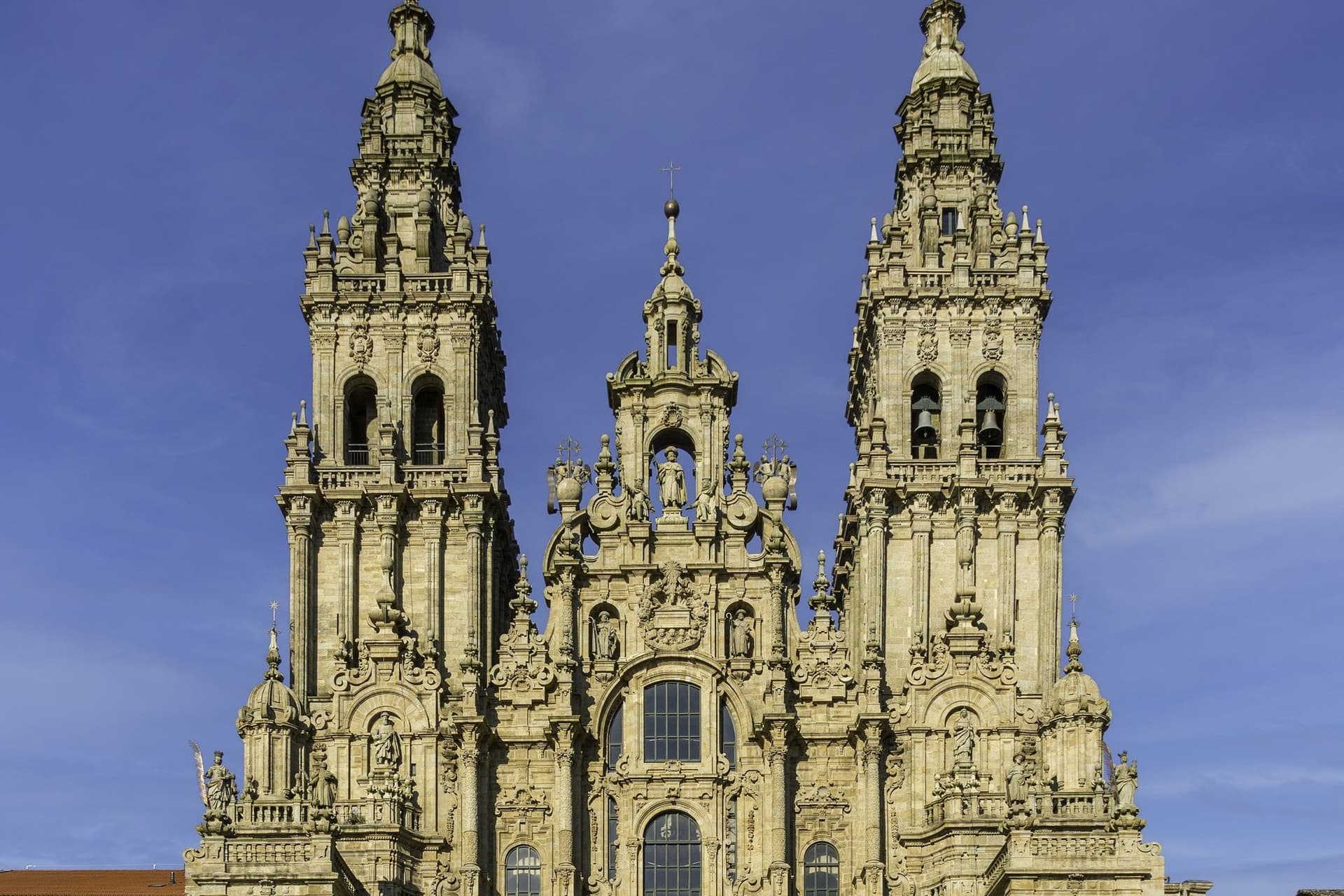
The arrival in Santiago is the moment the whole tour builds toward, and it is the moment we have watched hundreds of times without it losing any of its force. The group walks the last two kilometers through the outskirts of the city, enters the old town through a stone archway, follows the narrow streets downhill, and emerges into the Praza do Obradoiro with the Cathedral filling the entire western side of the square. People stop. Some cheer. Some go quiet. Some cry openly. The Cathedral has been receiving pilgrims since the ninth century, and the weight of that continuity is something you feel in your chest, not your head. After the square, we go to the Pilgrim Office to collect the Compostela certificates, and then to a long celebratory lunch where the Albarino wine flows and the stories from the trail start to become the stories the group will tell for the rest of their lives. If you are considering this for your group, start the conversation. The best windows are spring and autumn, and the most popular dates fill early.