A 10-Day Spain Soccer Tour, Day by Day
23 May 2026 · Juan Sanchez, Director, Odisea Tours

23 May 2026 · Juan Sanchez, Director, Odisea Tours
Every Spain soccer tour we run is custom built, but the shape of a 10-night trip across Madrid, Valencia and Barcelona has held steady for the last decade because it works. Two training cycles, two matches, two stadium days, a rest day in the middle, and three cities that teach the players a comparative lesson about Spanish soccer they cannot get from one base. This post is the day-by-day version of that trip, written from the operator side of the bus, the way it actually runs when a group of twenty under-sixteens from California or Sydney lands in Madrid on a Tuesday morning in October.
We are publishing this because new clients ask for it constantly, and the brochures we send back never quite capture the texture of a real tour. The brochure tells you that the group trains at the Spanish FA and visits the Bernabéu. It does not tell you why we schedule the stadium tour for Day 3 instead of Day 1, why the bus to Valencia leaves at 09:30 and not at 08:00, or why we put the rest day in the middle and not at the end. Those are the small operator decisions that decide whether a tour lands properly. We have made them thousands of times. Here is what they look like in sequence.
The first day of a Spain tour is not really a tour day. It is a recovery day with the appearance of a tour day, and the operators who treat it as a real day are the ones who blow up their own week. The group lands at Madrid Barajas, typically between 09:00 and 11:00 from a US East Coast red-eye or between 06:30 and 08:30 from a Sydney or Brisbane flight that connected through Doha or London. Our trip leader meets the group at the arrivals door with a printed sign and a smile, runs a head count before anyone walks fifty meters, and walks the whole group to the private coach waiting at the terminal exit. The coach drives directly to the hotel, which is by design a fifteen-minute ride from the airport and not in the center of Madrid. We learned long ago that fighting Madrid traffic on Day 1 with a planeload of jet-lagged teenagers is a mistake.
Check-in happens at noon, which the hotel holds for us because we book early and we book the whole floor. Rooms are pre-assigned from a list the coach sends two weeks before departure, which removes the queue of twenty kids and three adults arguing about who is in with whom. Bags drop. Players have ninety minutes of unstructured time, which means showers, naps, and a slow drift toward the lobby. We do not schedule a training session on Day 1. We do not schedule a stadium tour. We do not even leave the hotel for lunch, which we serve in the hotel restaurant where the kitchen has already been briefed on every dietary requirement on the roster. Mid-afternoon, the trip leader holds a fifteen-minute team meeting in the function room: tomorrow's schedule, the rules of the road in Spain, the curfew, the emergency card we hand each player with the hotel address and our local mobile number in Spanish and English. By 19:30 the group walks ten minutes to a restaurant we have used for fifteen years, eats a proper Spanish dinner under a vaulted brick ceiling, and is back at the hotel by 22:00. Lights out by 23:00, which is the only curfew that ever gets respected on a tour because by 23:00 on Day 1 nobody has the energy to fight it.
Day 2 is when the tour actually begins, and we begin it on purpose at the Spanish Football Federation's headquarters at Las Rozas, north of Madrid. The reason is straightforward. The Spanish FA is the most serious training environment any visiting youth team will set foot in during their trip, and starting there sets the bar for the rest of the week. The complex sits in the Sierra de Guadarrama foothills, twenty-five minutes from central Madrid, with multiple full-size grass pitches, an indoor facility, a residence where the senior national team stays during international windows, and a dining hall the players eat in at lunch. Walking through the gate on a Wednesday morning in October, past the framed photos of every Spain squad that has won a major tournament, is the moment most players understand what they have come for.
The session itself runs two hours. A Spanish FA-credentialed coach takes the group through a warm-up, technical work, a positional progression, and a small-sided game with a tactical brief at the start. Our trip leader translates in real time. The home coaches who run the visiting-group sessions are good. They know how to read the level of a visiting squad in the first fifteen minutes and adapt without making it obvious. They will compliment a player publicly. They will correct a player in private. They will work the goalkeepers in a separate area for thirty minutes with a specialist. By the end of the session the players are tired, slightly stunned, and already speaking about the Spanish coach by his first name. Lunch is served at the federation's dining hall, the same room the national team eats in, and the food is genuinely excellent, which is a small joke we let the players figure out on their own. Afternoon back to the hotel, a short walking tour of Madrid's Retiro park to keep the legs loose, dinner at the hotel, lights out early. Tomorrow is the Bernabéu day, and they need to be sharp for it.
We deliberately schedule the Bernabéu stadium visit for Day 3 and not Day 1. The reason matters. A stadium tour on Day 1 lands as a sightseeing visit, the same way it would for a tourist family on a city break. A stadium tour on Day 3, after a real training session in a real federation environment, lands as part of the soccer story the group is now living inside. The Bernabéu is the most ambitious stadium build in world soccer, the rebuilt version with the retractable roof, the liftable pitch, and the golden skin that changes color in the afternoon light. The full guided tour takes ninety minutes, includes the changing rooms, the tunnel, the bench, the pitchside, the trophy room with the fifteen Champions League trophies, the press room where every televised post-match interview happens, and the museum, which is the single best soccer museum in Europe.
We book the tour for late morning, when the angle of the light through the glass facade is strongest and the crowds are still thin. Players take photos at the bench, sit in the press room and pretend to take questions, stand in the tunnel and feel the floor vibrate underneath them. The trip leader has done this tour ninety times and still notices the moment a fifteen-year-old realizes what they are standing in. Lunch is at a restaurant in the Chamartín neighborhood ten minutes from the stadium, where we have a private room reserved that holds thirty without anyone having to shout. The afternoon is free time on the Gran Vía and at Puerta del Sol, in supervised small groups with a meeting time and a meeting point. Some players buy a Real Madrid shirt. Some players buy nothing. By 20:00 the whole group is back at the hotel. Dinner that night is at a tablao in the Madrid center, a traditional flamenco dinner show that the adults love and the players grudgingly admit was better than they expected. Back to the hotel by 23:00. Tomorrow is match day.
Match day in Madrid is the first competitive moment of the tour, and we treat it the way we would treat a regional semi-final at home. The opposition is confirmed in writing two months before the group arrives. For a U16 team from the West Coast on a development tour, the opponent might be the U17 side of a Tercera RFEF club from the Madrid region, an organized, properly coached youth team one tier below the professional pyramid, competitive without being humiliating. For a U14 team from a private school in Texas, it might be the U15 side of a Segunda RFEF affiliate. We name the club. We confirm the age group. We pick the right tier. The matches are played on real grass, with Spanish federation referees, on a Wednesday or Thursday evening between 17:00 and 19:00, which avoids the worst of the heat in summer and gives us match-quality light all year.
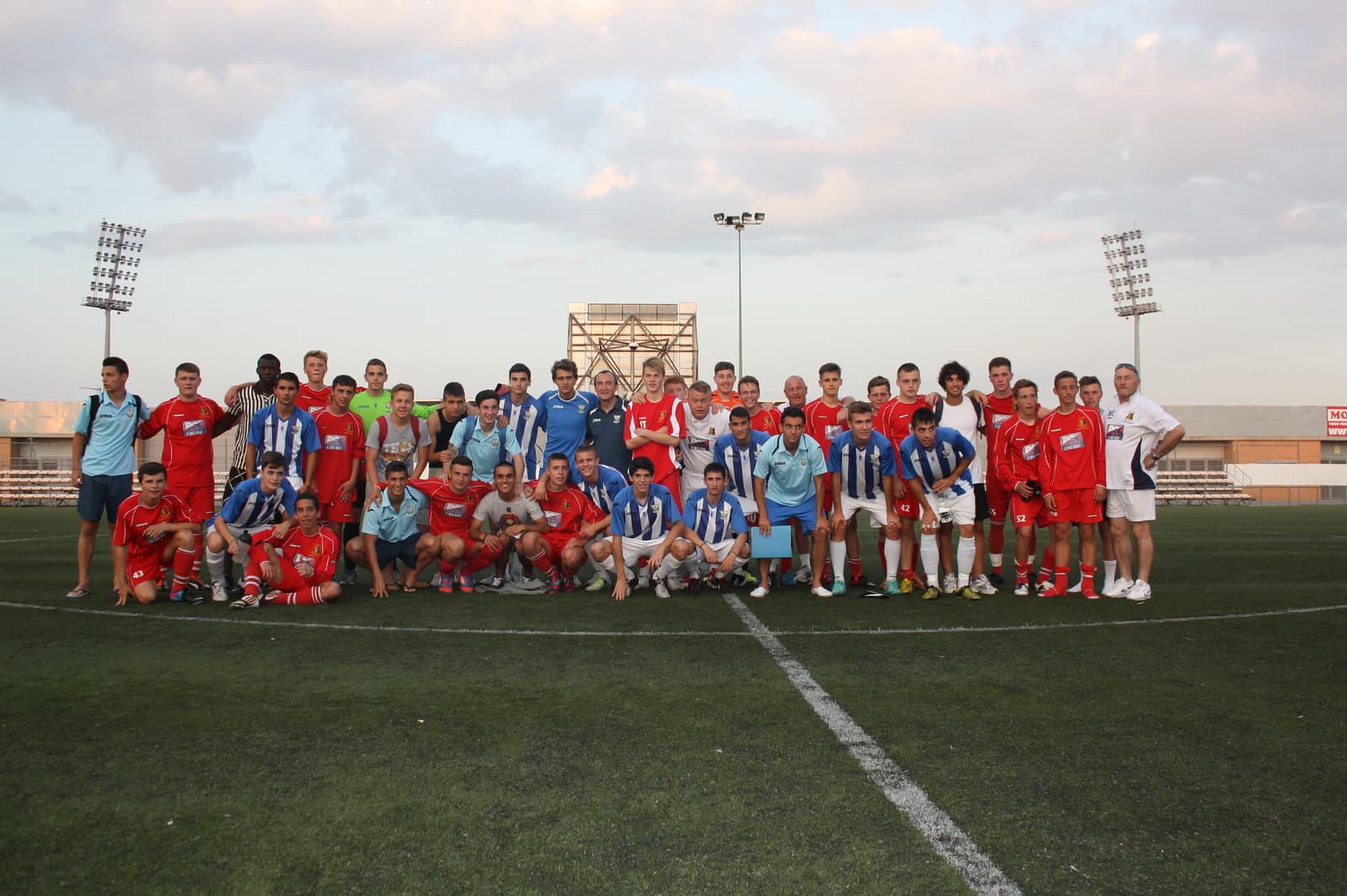
The day itself is paced for performance. A late breakfast, a short walk, a video review session in the function room at the hotel where the head coach previews the opponent in twenty minutes. A light lunch around 13:00. A pre-match meal at 15:00 of pasta with chicken and bread, prepared by the hotel kitchen to our standing pre-match brief. The team meets in the lobby at 16:00 in full kit, boards the bus, and arrives at the pitch ninety minutes before kickoff. The home club has a small clubhouse where the visiting team gets a dressing room, water, and a quiet space for the head coach's team talk. The match itself almost always plays out the same way. The first twenty minutes are tight while both sides figure each other out. The middle thirty minutes are where the Spanish side typically takes control, because their team chemistry has been built over years and the visiting side has been together for fifteen days, of which ten of them were in a plane or a hotel. The last twenty minutes are where the visiting team adjusts, makes substitutions, and finishes the match strong. The result, almost always, does not matter. What matters is the post-match handshake line, the photo with the home team that the home coach insists on, and the bus ride back to the hotel where twenty teenagers process what just happened on a Spanish pitch in front of forty Spanish parents who applauded politely for both teams. That ride is one of the moments the tour was built for.
Day 5 is a travel day, and the operators who try to crowbar a training session or a cultural visit into a travel day are the ones who lose the second half of the tour. We have made this mistake. We do not make it any more. The group checks out of the Madrid hotel at 09:00, boards the bus at 09:30, and rides four hours south-east to Valencia along the A-3 motorway, through the high plains of Castilla-La Mancha that look like the openings of every Spanish film the players have never seen. We stop once at a roadside cafeteria fifteen minutes outside Albacete for an early lunch of bocadillos, fresh fruit and one coffee per adult. We pull into Valencia at 14:30. We check into the hotel by 15:00. The afternoon is intentionally and aggressively unstructured.
Players are given the rest of the day off until a 20:00 dinner in the Ruzafa neighborhood. Some sleep. Some walk to the beach, which is a twenty-minute tram ride from the hotel and as flat and warm a Mediterranean beach as exists in Europe in October. Some go with a parent to the central market, which is the most beautiful daily food market in Spain. Our trip leader is in the hotel lobby with a phone and a city map, available to anyone who needs a translation or a recommendation, not pushing an itinerary. Dinner that evening is a Valencian paella, the real one, made in front of the group in a wide flat pan over a wood fire, with the socarrat layer at the bottom that the chef shows the players how to scrape with a spoon. The energy of the group on the second night in a new city is the moment the tour stops feeling like a school trip and starts feeling like an adventure. The bus driver gets a glass of wine at the end of the meal. So does the trip leader. Lights out by 23:30. Tomorrow is Paterna.
Valencia is the secret weapon of a Spain soccer tour, and Day 6 is why. Valencia CF's training ground at Paterna is twenty minutes outside the city, set into a hillside on the edge of a small industrial town, and the experience there is fundamentally different from Madrid or Barcelona. Where the Spanish FA is institutional and Joan Gamper is a campus, Paterna feels like a working club. There is no museum. There is no gift shop. There is a security gate, a sign, a pitch, and a coach. The visiting-group session at Paterna is led by Valencia CF coaching staff and built around a more direct, more aggressive tactical pedagogy than the possession-first approach the players experienced at the Spanish FA two days earlier. The contrast is deliberate. The players spend the first thirty minutes wondering what is different and the next ninety figuring it out.
Lunch is at the club restaurant next to the training pitches, a relaxed buffet that the players are now hungry enough to attack properly. After lunch we drive twenty minutes into the city to Mestalla. The stadium is one of the oldest in continuous professional use in Spain, the stands are vertical in a way no modern stadium is, and the tour takes the group through the dressing rooms, the tunnel, the dugout area, and the presidential box, which still looks like a senator's office from a 1950s film. The total time inside the stadium is around an hour. The players take photographs at the bench. The trip leader points out the section of the stand where the Mestalla ultras sit during a derby and explains, with restraint, what a Valencia versus Levante derby is actually like. We leave the stadium by 17:00. The evening is dinner in the city center, a casual sit-down meal at a tapas restaurant on a pedestrianised street, where the players eat with their hands and the parents drink albariño. By 22:30 everyone is walking back to the hotel through streets that are still busy because Valencia eats late. Lights out by 23:30. Tomorrow is a long bus, and we leave early.
The Madrid to Valencia bus is four hours. The Valencia to Barcelona bus is three and a half. We schedule the Valencia to Barcelona leg on Day 7 not because we have to but because the arrival into Barcelona at the end of a tour, after the players have already trained at the federation and at a La Liga club, hits differently than it would on Day 1. Barcelona, for a teenager who has spent six days learning what Spanish soccer takes seriously, lands as the emotional culmination of the trip and not as a starting point. The drive itself runs north along the Mediterranean coast on the AP-7, past Castellón (which is where Odisea is based, and which the trip leader will point out without making a speech about it), past the wind turbines on the ridges above Tarragona, and finally into the southern outskirts of Barcelona around 14:30.
We check into the hotel in the Eixample district, which is central enough to walk to the Gothic Quarter and far enough from Las Ramblas to sleep. The afternoon is intentionally light. A walking tour of the Gothic Quarter at the golden hour, led by our trip leader and a local guide who has been working with us since 2009, takes the group through the Plaça del Rei, the Cathedral, the Carrer dels Banys Nous where the silversmiths used to work, and ends in a square with a guitar player and an outdoor café. Players sit. Adults order vermouth. The light goes orange. Dinner is at 21:00 in a restaurant we have used for nineteen years where the chef remembers our trip leader by name and brings out a plate of pan con tomate before we have even ordered. Back at the hotel by 23:30. Tomorrow is the day many of the players will tell their parents about for the rest of their lives.
FC Barcelona's training complex at Joan Gamper is the most famous youth-development facility in world soccer, and the visiting-group session here is the one most teams come to Spain for. The complex sits next to the Camp Nou site, and the entrance is unmarked, which is by design. The security gate, the long driveway, the row of pitches behind a low concrete wall, the small Lluís Companys logo on the side of the administrative building. There is no gift shop. The session itself is two hours, run by FC Barcelona academy coaching staff, built around the Cruyff-era positional play and rondo progressions that the club still teaches its own under-twelves. The progression is deceptively simple. Three small-sided rondos. A positional game in a fifteen-by-fifteen grid. A small-sided game with constraints. By minute thirty the visiting players understand that what they have been told all their lives is just a rondo is actually a positional teaching tool with twenty layers of complexity. By minute ninety the head coach of the visiting team is taking notes.
The session ends with a brief talk from the FC Barcelona coach, often translated by our trip leader on the spot, about what they have just seen and what they should take home with them. A certificate is presented to each player at the end, individually, by name. We are not above describing this in marketing language: the photo of a fourteen-year-old American shaking hands with an FC Barcelona academy coach in front of the team crest is the photo their parents print and frame. We arrange for a group photo on the pitch. We arrange for individual photos with the coach if requested in advance. Lunch is in the club's training-ground restaurant, which is where the senior squad eats. The food is, for the third time on this tour, genuinely excellent. Afternoon free, dinner together at the hotel restaurant, an early night because tomorrow is Camp Nou and a La Liga match and the players need every hour of sleep we can build into the schedule.
Day 9 is the longest and most charged day of the tour. We split it into two distinct halves. The morning is Camp Nou. Even mid-renovation, the stadium still does what no other ground in Europe does to a teenager who walks into it for the first time. The Immersive Tour takes the group through the visiting team's dressing room, the players' tunnel, onto the pitchside, up to the commentary boxes, and through the museum, which is the most-visited museum in Barcelona ahead of the Picasso. Players photograph everything. The trip leader keeps the group moving but not rushed. By 12:30 we are out of the stadium, by 13:00 we are at lunch at a restaurant we have used for so long that the owner refuses to let us pay him on the last day of every tour.
The afternoon is free until 17:30, when the group meets at the hotel in full club shirts. Tonight the players are attending a La Liga match. The fixture depends on the calendar. In October it might be Barcelona against Real Sociedad or Espanyol against Atlético Madrid. In April it could be Girona against Sevilla. We have a relationship with a ticket broker who allocates a thirty-seat block in the second tier of the home end at every game we attend, so the group sits together. We arrive at the stadium ninety minutes before kickoff, walk in with the locals, and spend twenty minutes in the concourse before taking our seats. The match itself is a backdrop for the experience of being inside a Spanish stadium on a Wednesday night with forty thousand people who care more than any home crowd the players have ever experienced. The bus is waiting outside the away gate at the final whistle. We are back at the hotel by 23:30. Dinner is sandwiches the hotel has prepared and held in the function room. Players eat in fifteen minutes and go to bed without prompting. Tomorrow is the last day.
The last day is short on schedule and long on feeling. Breakfast at the hotel is unhurried. The trip leader hands each player a small printed envelope with a USB drive of the match-day photos and a handwritten note from Odisea Tours. The head coach makes a short speech in the lobby, thanks the trip leader, thanks the bus driver, and reminds the players that what they did on this tour is not over the moment they board the plane. At 11:00 we leave the hotel for a final group brunch at a restaurant in the Born neighborhood where the windows are open onto a small medieval plaza. The food is jamón, manchego, pan con tomate, tortilla, and the kind of bread that the players have learned over ten days to recognize as different from what they get at home. The owner brings out a plate of croquetas the players did not order and tells the trip leader, in Spanish, that this group was better behaved than the last one.
By 13:30 the bus is at the restaurant. By 14:30 we are at the airport. Our trip leader walks the group to the check-in counter, watches the bags onto the belt, sees the group through security, and waves from the rail above the departures hall. The players wave back from the escalator. The head coach, on the way through security, almost always turns around and thanks the trip leader one more time. The trip leader rides the empty bus back to the city with the driver, who has been on every kilometer of this tour. They get coffee at a service station outside Barcelona on the way back to the depot. They talk about which group this one reminded them of. They book the next tour into the calendar the next morning. The photo book arrives at the head coach's office in the States or in Australia three weeks later. The phone call from a parent, the one that says my child came home different, arrives roughly a month after that. The tour is finished. The change is permanent.
What this post leaves out, because no public document can include it honestly, is what goes wrong on every single tour. The flight delay that arrives two days before departure and breaks the Day 1 timing. The player who loses a passport on Day 4. The hotel that double-books a floor. The food poisoning that takes three players out of a training session. The bus that breaks down between Valencia and Barcelona on the AP-7. None of these failures are hypothetical. All of them have happened to groups we have run. The reason we still recommend a 10-night tour through three cities, after twenty years of these failures, is that the recovery from each of them is what builds the trust the group leaves Spain with. The flight delay is solved by the trip leader rebooking everything by phone in ninety minutes. The lost passport is solved by the embassy contact already in our coordinator's phone. The food poisoning is solved by the doctor we have on call in Madrid, Valencia and Barcelona. The bus breakdown is solved by a replacement coach that meets the group at the next motorway service station within forty-five minutes. None of those solutions are visible in the brochure. All of them are why the tour works.
If you have read this far, you are almost certainly planning a tour. The honest next step is a call, not a quote. Tell us your squad size, your age group, your home city, your travel window, and your hard budget per player. We will come back inside seven days with a draft itinerary that names the hotels, names the training facilities, names the opposition tier, names the cities, and prices the trip per player without hiding anything. Start the conversation here. The full breakdown of pricing, training facilities, audiences and the four formats we run lives on the Soccer Tours in Spain pillar guide. The day-by-day above is one shape of the trip. The right one for your group is the one we build with you.
Most youth and high school tours run 7 to 10 nights. Our most-booked shape is 10 nights across three cities (Madrid, Valencia and Barcelona), which gives the group two real training cycles, two friendly matches, one La Liga night, two stadium days and a rest day in the middle. Anything shorter than 7 nights burns half the trip on airport transfers. Anything longer than 12 starts to fatigue younger players.
Because Spanish soccer is not a single thing. Madrid is national-team scale, the Spanish FA, the Bernabéu. Valencia is human-scale, intimate, Mediterranean, the home of a different coaching pedagogy. Barcelona is the Cruyff legacy. Putting the players in all three teaches a comparative lesson no single city can replicate. The bus days between them are part of the trip, not a tax on it.
Two hours on the pitch in the morning at a professional or semi-professional facility, run by a Spanish coach with our trip leader translating. A sit-down lunch after, dietary requirements briefed in advance to the kitchen. An afternoon that is either a cultural visit, a friendly match, or unstructured free time depending on the day shape. Evenings are group dinners and supervised downtime. Two training days, two match days and two stadium days are the spine of a 10-night tour.
Two friendlies per week against Spanish academy or amateur sides matched to your age and level. Two is the right number. Three over-fatigues younger players and the second-week match degrades. One is not enough to justify the trip. Fixtures are confirmed in writing with the club name and the specific opponent age group before departure.
Riding the bus with the group every kilometer. Translating training sessions and team talks. Confirming the next day's training facility access by phone with the home club. Briefing every restaurant on dietary requirements before the group arrives. Carrying first aid, emergency contacts and a card with the local hospital network. Answering the phone at 02:00 if a passport gets lost. The coach coaches. The trip leader handles the country.